
2022 · Feedback loops
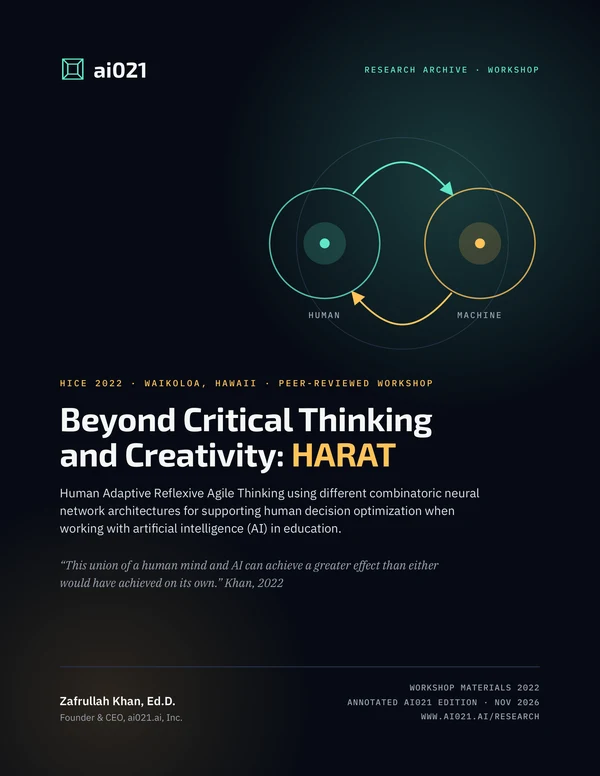
“Recursive iterative feedback loops generated by both learning systems.”
2026 · at ai021
NanoSI’s verification loop: a model answers, the answer is checked against its sources, and people correct the knowledge. ai021 began as a peer-reviewed idea about people and machines thinking together. Four years later it is NanoSI: small language models built from scratch, fine-tuned and run offline on edge devices. White Paper No. 1 connects the two.

The paper that explains why ai021 exists: what the 2022 workshop argued, what has changed since, and how those ideas became a device that works with no internet connection.
Each step on this line happened in public or is marked as a plan.
HARAT submitted to the Hawaii International Conference on Education and accepted through peer review.
Presented in Waikoloa, Hawaii: humans and AI as one feedback loop, with human judgment at the centre.
Generative AI reaches the public. An industry event, shown for context; not an ai021 milestone.
Industry contextA method for building small language models from scratch and fine-tuning them, and nine published books.
The first NanoSI edge device and three products, StickyWork, StickyMesh and StickyStudio, are demo-ready.
More edge devices, then ai021’s own AI operating system. These are plans, not products.
Plan“Recursive iterative feedback loops generated by both learning systems.”
“AI is limited to the data and information that is programmed.”
Machine intelligence will become “embodied, embedded, distributed, situated, ‘ambient’ and pervasive.”
Quotations are from the 2022 workshop materials. The “now” column is ai021’s 2026 interpretation.
Free to download and read. Please cite the paper if you use it.
Human-centered, verifiable intelligence at the edge: how a theory of human–AI co-thinking became private, offline, source-linked AI.
Human Adaptive Reflexive Agile Thinking using different combinatoric neural network architectures for supporting human decision optimization when working with artificial intelligence (AI) in education.
Our research bet is that more capable AI should be built on structure that can be inspected and verified, not only on scale. These are research directions, not available products.
Small language models that answer from structured, source-linked knowledge and say when the sources do not support an answer.
Load testing the first device over a local router to confirm or revise the projected 300–500 simultaneous users.
Ways for people and models to learn from each other, from the HARAT feedback loop to classrooms, teams and field sites.
Research toward ai021’s own AIOS for edge devices. A plan on our roadmap, not a product.
2022 text is quoted as it was written. Anything we add later is labelled with its date.
A number that has not been tested is marked “projected” until it has been.
We protect our IP. Product images are illustrations and are labelled that way.
Roadmap items are described as plans until they exist.
Educators, labs and organizations exploring private, offline AI: tell us what you are working on.
Build with the AI communityThe first NanoSI device and the Sticky suite are ready for live investor demonstrations.
Book a demoThis page describes research, products in development and plans. Statements about future plans are aspirations, not promises. Nothing on this page is an offer to sell, or a solicitation of an offer to buy, any securities.