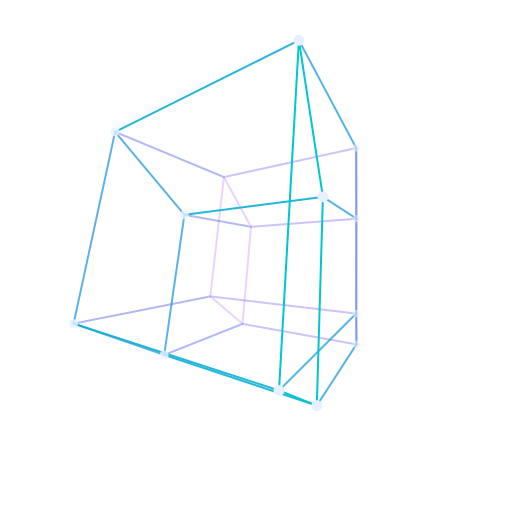
Wireframe of a tesseract: an outer cube and an inner cube, joined vertex to vertex.
The wireframe is a tesseract, a four-dimensional cube, drawn as its shadow. Edges run from violet, farther along the fourth dimension, to cyan, nearer. Pause keeps the current frame.

The tesseract, explained

NanoSI is built on one idea: give every fact an address you can check. The tesseract is how we picture that address.

In 30 seconds

Why a tesseract?

A square locates things in two directions. A cube adds a third. A tesseract adds a fourth. You can’t see it directly, but you can see its shadow, the rotating shape above.

Most AI keeps what it “knows” blurred inside billions of numbers. You can’t point to where a fact lives or where it came from. NanoSI does the opposite. It places every fact at a precise point in a four-dimensional lattice. One direction says what it’s about, one says how it connects, one says where it came from, and one says when it was true. Because each fact has an address, every answer can be walked back, step by step, to its source.

In 3 minutes

From dots to addresses.

A list of facts is one-dimensional. A knowledge graph connects facts, so you can see how things relate. That’s two dimensions. NanoSI adds two more to every connection: the source (which document, which page) and the time (when it was true). Four coordinates per fact is what makes the structure a four-dimensional lattice, a tesseract.

Why the shape rotates.

A 4D object can’t be drawn directly. The animation shows its shadow in 3D. As it turns, the “inner” cube becomes the “outer” one. That is a good metaphor for the product: one body of knowledge, viewed from different angles. By topic, by relationship, by source, by time, it’s the same facts, still connected.

Why it matters to a business.

  • Audit: any answer can be walked back to the lines of the documents behind it.
  • Cost: the model learns how to reason over the lattice rather than memorising everything, so it can stay small. Small models are cheaper to run and practical on-premise.
  • Honesty: if a fact isn’t in the lattice, the right answer is “not supported”, not a guess.

Why not just a bigger model?

NanoSI keeps facts in the lattice, where each one can be traced. Training teaches the model the habit of reasoning over the lattice and citing it. An answer that is not supported stays unsupported.

Smaller, well-trained models can beat larger ones on a defined task. The sources we point to are Hoffmann et al., Training Compute-Optimal Large Language Models (Chinchilla), Ouyang et al., InstructGPT, and the SmolLM3 model card.

The Foundry, stage by stage

Miner

In: documents and databases. Out: candidate facts (subject, relationship, object) plus source location. Checks: entity resolution, duplicate removal, personal-data screening.
Hyper-Lattice

In: candidate facts. Out: the four-dimensional, source-linked lattice. Checks: schema, contradictions, consistency over time.

Curriculum

In: the lattice. Out: three tiers of training lessons. Synthetic examples stay flagged and are kept apart from evaluation data.

Fusion Model

In: the curriculum. Out: a compact model, possibly small adapter modules (LoRA) on an open base model.

Evaluation (graph-critic)

In: model outputs. Out: metrics plus an audit trail, scored on a private, pre-written test set.

Three-tier curriculum

Examples are illustrative.

  1. Tier 1, single facts: “Policy 4.2 requires annual review.”
  2. Tier 2, two-step patterns: “Contract A references Policy B; Policy B requires approval C.”
  3. Tier 3, multi-step chains with conditions and dates: “Which contracts are affected if this vendor becomes insolvent?”

Verification loop and audit trail

Each answer is a path: source passage, then a point in the lattice, then a reasoning step, then the answer. The same facts stay connected. Nothing here is a live model output.

  1. Source passage
  2. Lattice point
  3. Reasoning step
  4. Answer

Measurement and known limits

Known limits

  • Results depend on document quality, lattice completeness and domain.
  • The lattice can only verify what it contains.
  • No guaranteed performance level.

Pilots and deployment

A pilot is a one-page spec, a private evaluation set, written success and stop criteria, then build, evaluate and hand over.

Planned deployment options: cloud, your cloud, on-premise, air-gapped.

Discuss a pilot

Glossary

Structured Intelligence
AI whose knowledge sits in an explicit structure that can be inspected, so answers can be traced and checked.
NanoSI
Nano Structured Intelligence: ai021’s method for building small, domain-specific models that answer from a verified lattice of facts.
Tesseract
A four-dimensional cube. NanoSI’s picture of how each fact gets a four-part address.
Tesseract lattice / Hyper-Lattice
NanoSI’s store of facts. Each fact is linked to what it’s about, how it connects, where it came from and when it was true.
Foundry
The five-stage pipeline: Miner → Hyper-Lattice → Curriculum → Fusion Model → Evaluation.
Miner
Extracts facts from documents and records their source.
Provenance
Where a fact came from: document, section, page.
Curriculum
Training lessons generated from the lattice, ordered from easy to hard.
Fusion Model
The compact model trained to reason over the lattice and cite it.
Verification loop
Checks each claim in an answer against the lattice and its sources.
Graph-critic
NanoSI’s evaluation method.
Audit trail
The record linking an answer to its facts and documents.
Hallucination
A fluent answer that isn’t supported by facts.
Grounding / retrieval
Giving a model real source text at the moment it answers.
Fine-tuning
Further training on focused examples. It mostly changes behavior, not knowledge.
LoRA / QLoRA
Fine-tuning small add-on weights (QLoRA also compresses the base model), so it fits on modest hardware.
Small language model
A model small enough to run privately or on-premise.
Token
A small piece of text. The model predicts one at a time.
zAfi
ai021’s long-term research direction (research, not a product).
NSRM, NanoTRM, Thought Trace
Research concepts on /zafi.